Hideo Nomo arrived with a bang in the United States in 1995, when the 26-year-old rookie pitcher for the Los Angeles Dodgers won the Rookie of the Year Award and made the National League All-Star team. The nation was gripped by "Nomomania," and not even a diehard Red Sox fan located 3,000 miles from Dodger Stadium was immune to the outbreak.
Sixteen years later, Nomomania is the closest thing imaginable to "Linsanity," the fever over Knicks guard Jeremy Lin that has taken hold of NBA fans and non-fans alike.
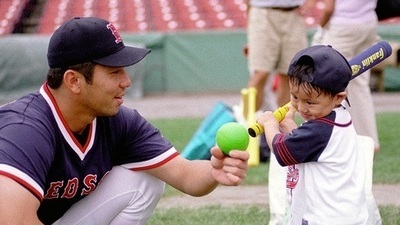
As a 12-year-old of Japanese descent, I caught Nomomania worst than most, but the furor knew no racial boundaries. Every young boy's Wiffle ball pitching windup was ruined that summer in an attempt to copy the "Tornado." Imitation is the sincerest form of flattery, as a generation of New England Little League infielders would prove a few years later by flinging wild, side-armed throws in the style of Nomar Garciaparra.
Nomo went 13-6 with a 2.54 earned run average in 1995 while leading the NL with 236 strikeouts and three shutouts. He had just two strong seasons after that, going 16-11 with a no-hitter in 1996 and 13-10 with an AL-high 220 strikeouts in 2001, when he threw his second career no-hitter.
A writer for The New York Times compared Lin's story to Jackie Robinson, which goes a little too far. Lin doesn't face the personal or social challenges Robinson faced in 1947 when he broke baseball's institutional color barrier. But like African Americans watching Robinson in 1947, Asian Americans watching Nomo in 1995 and Lin in 2012 battled a "cringe" factor — simultaneously proud to root for one of their own but constantly nervous that some misstep will bring it all to a halt.
Lin's rise could go into a nosedive in the near future, and it's beyond rationality to believe he will continue his current pace of scoring close to 30 points and averaging more than eight assists per game. A few days' worth of excitement was worth making everyone forget about the ugly lockout that preceded this season, though, and that alone is a credit to Lin.
Now, if you'll excuse me, I'm going outside to practice my forkball.
Photo via Flickr/robcuni.com